How an AI conversation helped me rethink 30 years of experience in a changing job market
The current conversation about using AI for job search often focuses on prompts.
“What is the best prompt to write a resume?”
“How do I make ChatGPT optimize my LinkedIn profile?”
“What AI tool will beat the applicant tracking system?”
Those questions are understandable. Everyone wants the shortcut.
But after I started experimenting with AI during my own job search, I found something more interesting:
The most valuable thing AI did was not write for me. It helped me think.
Positioning: the latest word for an old idea
Every decade seems to create a new word for the same basic concept.
In the 1980s, we renamed job titles…
In the 1990s, everyone talked about networking…
Then came personal branding…
Now the popular word is positioning.
I have to admit, some of these terms make me laugh.
In 1982, I worked at a gas station. We pumped gas, checked oil, sold batteries, replaced windshield wipers, and occasionally sold tires.
Our official title?
Petroleum Transfer Technician.
A fancy title did not change the work.
But there is an important difference between simply renaming something and actually positioning it.
Renaming changes the label.
Positioning changes the context.
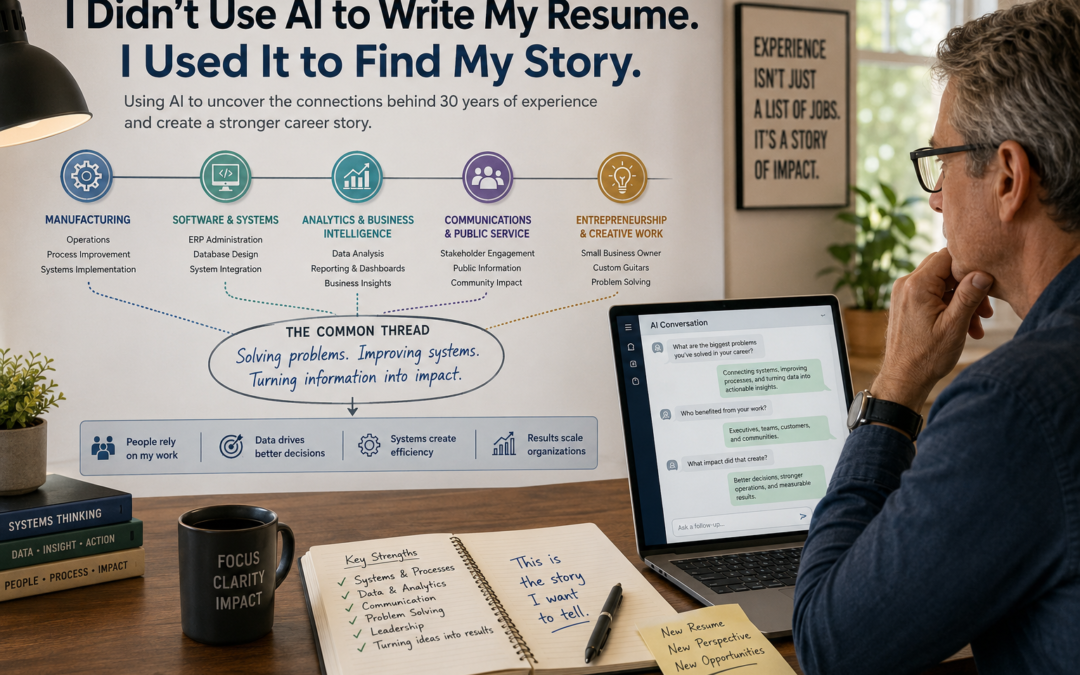
How I Used AI During My Job Search: My resume had the facts but it was missing the story.
When I began this experiment, I saw my career as a collection of unrelated experiences:
- Business Systems Analyst
- ERP and CRM administrator
- Website developer
- County employee
- Manufacturing entrepreneur
- Custom guitar builder
The challenge was obvious:
How do you explain a career path that crosses so many industries?
The answer was not to hide the variety.
The answer was to find the common thread.
AI did not know my accomplishments. I did.
This is the part that gets misunderstood.
The AI did not know:
- that M5 Financial supported a CRM database with more than 500,000 contacts
- that approximately 3,000 customers received loans through the organization
- that monthly loan production was measured in tens of millions of dollars
- that GIS Surveyors supported six divisions and more than 50 active projects
- that county work involved communications reaching hundreds of thousands of residents
Those details already existed.
They were just buried inside old job descriptions and memories.
The value of the conversation was asking better questions:
What was the scale?
Who depended on the information?
What decisions did this support?
What problem did you actually solve?
The difference between tools and capabilities
A traditional resume often lists tools:
- HubSpot
- SQL
- Python
- ERP
- CRM
- Analytics
But companies do not hire tools.
They hire people who solve problems.
The better question is:
What did you accomplish with those tools?
For example:
“Managed CRM”
is very different from:
“Supported commercial analytics operations across a 500,000+ contact database supporting a revenue-producing organization.”
Same experience.
Different perspective.
The human still matters
This is the part missing from many AI discussions.
AI did not decide my career direction.
It suggested possibilities.
I evaluated them.
Some ideas worked.
Some did not.
That judgment is still human.
AI can identify patterns.
Humans decide what those patterns mean.
The best results came from the combination:
My experience.
AI’s ability to recognize patterns and ask questions.
Human judgment about what was actually true and useful.
This is an experiment, not a guarantee
There is a growing industry promising that AI will solve job hunting.
Perfect prompts.
Perfect resumes.
Perfect LinkedIn strategies.
I remain skeptical.
A resume is not a vending machine where you insert keywords and receive interviews.
The real experiment is much simpler:
Can AI help someone understand their own experience better?
Can it help identify transferable skills?
Can it help communicate value more clearly?
That is what I am testing.
The future of AI may not be replacing experts. It may be helping experts see themselves differently.
The most interesting AI applications may not replace human judgment.
They may extend it.
A person knows their experiences.
AI can help organize those experiences into patterns.
Together, they can create something neither produces alone:
Better understanding.
The takeaway
If you are using AI for job search, don’t start with:
“Write me a resume.”
Start with:
“Help me understand the story my experience is telling.”
The best prompt may not be a prompt.
It may be a conversation.
Continue the experiment
I will continue sharing what happens as this approach is tested in the real job market.
The goal is not to prove that AI is magic.
The goal is to understand where it is genuinely useful.