AI is BS! Not because it doesn’t work—but because we are not talking about it honestly
Undeniably, AI is everywhere right now, but very little of the conversation around it is honest.
It is either described as:
- a near-magical intelligence that will transform everything overnight
- or a mysterious force that will eventually replace human work
Both narratives miss the reality.
Neither reflects what AI actually is.
What AI actually is
At its core, modern AI is a system trained to recognize patterns in data and generate likely outputs based on those patterns.
It does not think in the human sense.
It does not understand meaning the way humans do.
It does not have intent, awareness, or goals.
It is a powerful statistical system operating within constraints designed by humans.
That distinction matters.
Because it removes AI from mythology and returns it to engineering.
AI is part of a much longer story
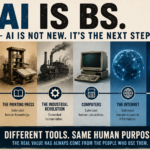
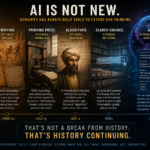
Human history is full of tools that extend cognition:
- The abacus extended arithmetic
- Writing extended memory
- The printing press extended access to knowledge
- Calculators extended computation
- Search engines extended information retrieval
AI belongs in that same lineage.
It is not a break from human technological history.
It is a continuation of it.
Each step does the same thing:
It externalizes a cognitive function and makes it faster, cheaper, or more scalable.
Why AI is BS: The marketing problem
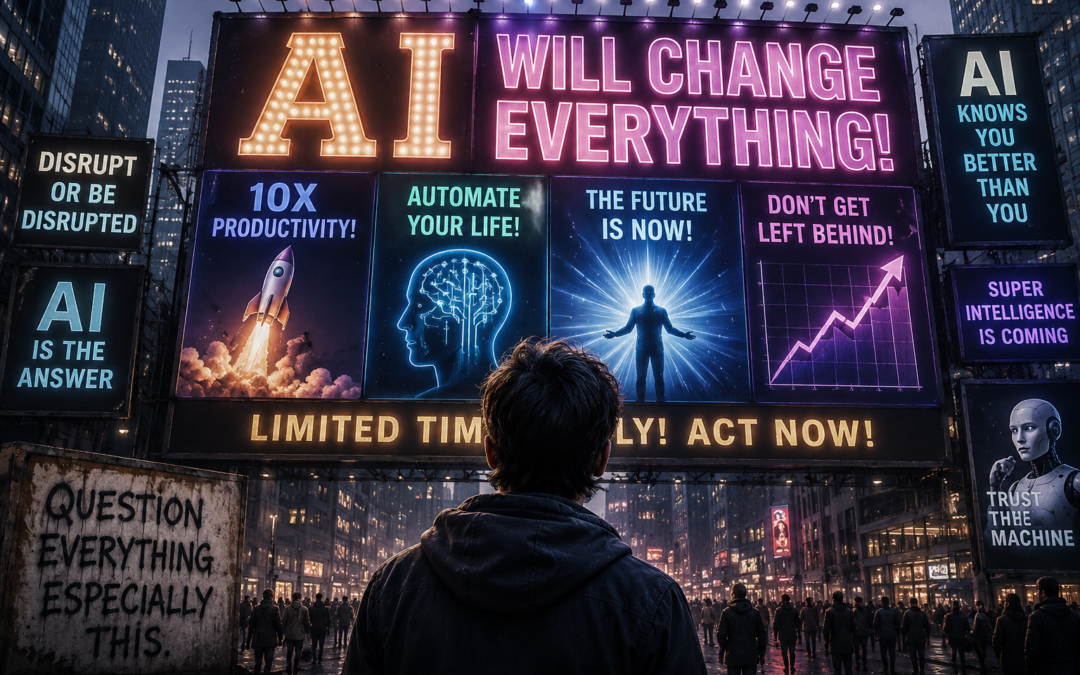
We are currently in a familiar cycle: urgency.
“If you don’t adopt this immediately, you will be left behind.”
We have seen this before with railroads, electricity, computers, the internet, and social media.
The pattern is consistent.
The technology is real—but the narrative often accelerates expectations beyond understanding.
The result is predictable:
- inflated expectations
- unclear understanding of limitations
- pressure to adopt before comprehension
This is not unique to AI.
But it is amplified by it.
Why clarity matters
AI is neither magical nor inherently dangerous in the way it is often framed.
A useful analogy is a screwdriver.
You can use it to build something useful—or you can misuse it and cause harm.
But we do not describe screwdrivers as dangerous technology.
We describe them as tools that require understanding.
AI is the same.
Closing thought
The problem is not that AI is unknowable.
The problem is that we are not talking about it clearly.
And in the gap between capability and understanding, mythology fills the space.